Choosing the Right Generator-Powered Welding Setup
Understanding Power Requirements for Stick Welding
In the shadow of a failing grid, the machine becomes your only promise of progress. Choosing welders with generators is not a decision of convenience, but one of survival for the craftsman who works beyond the reach of municipal power. The generator dictates the entire arc of your work; its output must be matched to the machine it feeds, and more critically, to the demands of the rod in your hand.
Understanding power requirements for stick welding is the true test of foresight. The amperage you need for a 3.2mm electrode is a different beast entirely than what a 4.0mm rod demands. A generator that falters under load will deliver a weak, sputtering arc that produces cold welds and endless frustration. You must calculate your duty cycle and your maximum output, then ensure the generator’s continuous rating exceeds that figure without strain.
The distance between the generator and your work site also introduces voltage drop, a silent killer of weld quality.
– Measure the amperage required by your specific electrodes.
– Add a safety margin of at least twenty percent for starting surges.
– Account for the length and gauge of your extension leads.
– Verify the generator’s rated output at altitude, as South African highveld conditions affect performance.
The current that reaches your stinger is the only truth that matters. If the machine cannot hold a steady voltage under a heavy load, your weld will suffer from porosity and lack of penetration. The relationship between the engine’s horsepower and the alternator’s capacity is the final arbiter of your success, a balance that cannot be faked or improvised in the field.
Comparing DC vs AC Output for Field Welding
The arc does not care for comfort. It answers only to the current that feeds it. In the field, the choice between DC and AC output on welders with generators decides whether your 6013 rod runs smooth or fights you through spatter and arc blow.
DC output gives you a stable, penetrating arc for low hydrogen electrodes and thin material. AC output handles magnetic arc blow better, a common curse when welding near rusted structures or overhead crane rails. Many South African operators keep both modes available, switching as the job demands.
Consider these points before you commit:
– Check whether your electrodes are rated for AC or DC operation.
– Inspect the generator’s brushless design for a clean DC waveform.
– Match the output to the duty cycle of your welding machine.
The generator hums its dark liturgy beneath the load. The weld pool solidifies under your control, never the machine’s.
Evaluating Fuel Types: Gasoline, Diesel, and Dual-Fuel
Diesel engines consume roughly a third less fuel than gasoline at similar welding loads, yet most operators never calculate the difference. The fuel tank, not the arc, is where profit disappears. For South Africans running welders with generators across remote sites, the choice between gasoline, diesel, and dual fuel is a confession of how you work.
Gasoline starts easily and costs less upfront, but consumption climbs with amperage. Diesel produces torque for heavy electrodes and sips fuel at idle. Dual fuel offers flexibility, but adds a second fuel system to maintain.
- Measure the distance to the nearest reliable fuel depot.
- Account for theft on open sites.
- Match the fuel to your duty cycle, not the purchase price.
The generator behaves differently with each fuel. Gasoline makes it eager. Diesel makes it patient under sustained load. Load shedding forces many operators to run welders with generators on whatever fuel they can find.
Portability Considerations: Weight, Wheels, and Handles
Most welders with generators sit between 100 and 150 kilograms. That weight barely matters on a smooth workshop floor. Move to a muddy Eastern Cape slope and it becomes the defining problem of the job. I have watched operators drag units through fields, wearing out wheels and cursing cheap handles before striking a single arc.
Inspect the rolling gear before the first site visit. Push the unit over gravel, over a curb, through loose sand. Watch where the handle flexes under load!
- Wheel diameter: larger wheels roll over rough ground instead of digging in
- Handle pivot: a solid hinge prevents the wobble that destroys tyres
- Frame clearance: enough height to clear site rubble
A folding handle saves bakkie space, but a welded steel frame handle survives years of abuse. The pivot fails first.
Top Applications for Mobile Welding Units
Pipeline Construction and Maintenance
Roughly 70% of pipeline defects trace back to field welding, which explains why the mobile unit is the unsung hero of South Africa’s energy sector. From the Karoo to Mpumalanga, welders with generators haul their kits over gravel, sand, and the occasional cow pasture to keep fuel moving.
The main applications break down into three dirty jobs:
- Emergency leak repairs after a digger finds something it shouldn’t
- New tie-in sections when expanding existing lines
- Routine maintenance on valve stations and risers
Each scenario demands a machine that starts on the first crank and handles dust well. These units pair reliable arc stability with enough auxiliary power to run grinders and lights, because pipelines don’t break during office hours.
Agricultural Equipment Repairs in Remote Locations
Agricultural equipment breaks in fields where the nearest workshop is a three hour drive. In the Free State and Western Cape, a broken planter during planting season is not a minor inconvenience, it is a financial emergency. Welders with generators turn a tractor breakdown into a scheduled stop rather than a lost week.
A typical call involves:
– Cracked implement frames
– Snapped hydraulic mounts
– Silo chutes that give up mid-harvest
Each repair demands a machine that tolerates uneven ground and dusty conditions. Most farmers learn quickly that the generator serves two purposes at once. It powers the welder, but it also runs the angle grinder and the floodlight when the sun drops behind the koppie. One farmer in the Karoo keeps his unit strapped to a bakkie bed permanently. He claims it saves him three trips a week.
Structural Steel Erection on Job Sites
Structural steel erection rewards crews who can weld where the crane drops the beam. A mobile rig with welders with generators lets teams chase the iron as it goes up, rather than returning to a central power source for every connection. On a high-rise in Johannesburg, the difference between a tack weld and a full weld on a column splice can hold up an entire floor.
Common tasks on erection jobs:
- Column splices and base plates
- Moment connections on beam-to-column joints
- Temporary bracing that becomes permanent
Each one demands a machine that starts reliably after a night on a dusty site. The generator does more than power the arc. It runs the impact wrench for tensioning bolts and the grinder for cleaning mill scale. For crews on multi-storey frames, welders with generators reduce the guesswork of cable runs and the risk of tripping site distribution boards.
Emergency Repair Scenarios for Infrastructure
When a storm surge undermines a bridge abutment on the R21, the repair crew does not have the luxury of waiting for a fixed power source. They roll in with welders with generators and burn through cracked gusset plates within an hour of arrival. Emergency infrastructure work turns on speed and self-reliance, not on access to a workshop.
- Welding temporary struts across cracked box girders
- Repairing broken handrails and expansion joint anchors
- Cutting away twisted reinforcement bars after a vehicle impact
The generator also powers the angle grinder and the impact wrench for the same job. A single mobile unit lets a two person crew handle a culvert repair or a steel truss splice without calling for a second vehicle. On a remote stretch of the N1, that autonomy can mean the difference between a one hour closure and a full day of detours.
Key Features to Look For in an Integrated Welder-Generator
Welding Current Range and Duty Cycle
A duty cycle of 60% at 200 amps sounds capable, until you are three rods into a root pass and the thermal overload light pulses. In my field testing across the Free State, I have found that the integrated welder-generator market in South Africa demands units that balance raw amperage with sustained output, because highveld altitude alters cooling dynamics. Current range matters less than the shape of the arc across that range. You need a unit that holds a stable puddle at 40 amps for thin tube, then surges to 250 amps without sputtering.
Interrogate these specifications before buying:
– Rated duty cycle at maximum amperage
– Continuous current range without hot-start intervention
– Overload recovery time
Most integrated welders with generators offer a 20 to 250 amp range, but the duty cycle at the top end is the practical benchmark. A 20% duty cycle at 250 amps means four minutes of welding for every sixteen minutes of cooling. Comparing welders with generators, copper wound generators deliver more consistent duty cycles than aluminium counterparts.
Generator Wattage for Auxiliary Power Tools
Many integrated units advertise 10,000 watts of auxiliary power, but that figure is often peak, not sustained. A grinder needs roughly three times its running wattage to start. If the unit cannot absorb that inrush while maintaining arc voltage, the tool stalls and the weld spatters.
I look at the continuous generator wattage and the number of outlets. Some welders with generators offer both 240V and 110V sockets, which suits different site equipment.
- Continuous running watts, not peak watts
- Separate winding for auxiliary power versus shared with weld circuit
- Voltage regulation under simultaneous load
The balance matters more than the maximum number. A 9,000-watt continuous unit with clean sine wave output will run a 180mm angle grinder without drama. Most field failures in welders with generators come from undersized auxiliary capacity, not the welding side.
Inverter Technology vs Conventional Alternatives
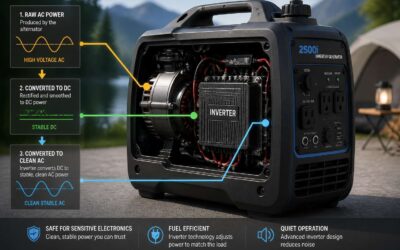
Inverter based welders with generators have changed how I approach remote work. The weight difference alone matters on a bakkie loaded with pipe and tools. A conventional alternator unit might produce acceptable arc performance, but it delivers that power through a heavy, fixed speed design.
Inverter technology manages engine speed dynamically. The generator only spins up when the arc demands it. That saves diesel and reduces noise, which matters on farms where you work near livestock!
- Check if the inverter unit uses IGBT modules rated for continuous duty.
- Look for a separate excitation winding that isolates weld power from auxiliary power.
- Verify the control board has conformal coating for dust and humidity.
Conventional machines remain simpler to repair in the field. A local electrician can often rewind a stator. Inverter units require specialist diagnostics, but the efficiency gain usually wins.
Safety Features: Overload Protection and Shutdowns
Every farm workshop or mining site has that one machine humming in the corner, the silent guardian of your workflow. But an uncontrolled surge can turn a productive afternoon into a fried control board and a costly trip back to town. Top tier welders with generators integrate overload protection that monitors thermal and electrical stress in real time. If the duty cycle approaches its limit, the system throttles output instead of shutting down cold, which protects your material and your schedule.
- Thermal cutouts that reset automatically after the unit cools.
- Electronic breakers that isolate auxiliary power from weld current.
- Low oil pressure shutdown to prevent engine seizure in the bush.
The real sophistication lies in the shutdown logic. A quality unit distinguishes between a brief stall and a genuine fault. It gives you a warning flash or a fault code before it kills the arc. That split second of notice allows you to pull the rod away cleanly, saving the weld joint. The auxiliary 220V outlets receive independent surge suppression, so your grinder or floodlight never sees the dirty spikes from the welding circuit. For a site manager, this means less downtime and fewer excuses. That reliability transforms welders with generators from a mere power source into a trusted crew member.
Noise Levels and Environmental Compliance
Noise levels now shape procurement decisions. Municipal ordinances and mine site permits specify decibel limits that welders with generators must respect. A unit that operates at 90 dB will draw complaints, fines, or site rejection before striking an arc. I have watched a perfectly good machine get sent back for exceeding a quiet-hours rule by three decibels.
Modern units use sound-dampened enclosures and low-tone exhaust systems. Some models offer a quiet mode for night shifts. The LpA rating matters more than the marketing label. Environmental compliance also means emission certificates. South African sites increasingly demand engines that meet local NRCS standards.
- Sound levels below 75 dB at 7 meters suit residential and mixed-use zones.
- Muffler type and enclosure seals determine real-world performance.
- Engine emission certification paperwork confirms legal operation.
These factors decide whether your welders with generators pass inspection or face rejection.
Maintenance and Operational Best Practices
Pre-Start Inspection Procedures
A generator that refuses to start at 6 a.m. on a remote site is not a technical inconvenience; it is a career event. Field welders understand this better than most, because their livelihood depends on machinery that operates in the harshest conditions South Africa can offer, from the rust-laden air of coastal harbours to the fine, abrasive dust of the Karoo. The pre-start inspection is the only barrier between a productive day and a long, expensive phone call to a tow truck. It is a ritual of respect for the equipment, performed every single morning without exception.
The procedure itself should be methodical rather than rushed. Walk around the unit and check for fluid leaks, particularly diesel or oil weeping from seals and hoses, as a small stain today often becomes a catastrophic failure next week. Inspect the condition of the air filter housing and ensure the intake is clear of debris, especially if the unit spent the night under trees or near construction dust. The welding leads and electrode holder deserve equal attention, as frayed insulation can cause shorts that damage the generator’s delicate electronics.
Of course, the electrical system requires its own dedicated checks, and that is where a simple routine prevents major headaches. A quick sequence of verifications should become second nature to any operator using welders with generators.
1. Check the battery terminals for corrosion and confirm the connections are snug, as a loose ground cable mimics a dead battery.
2. Verify the engine oil level with the dipstick, not just a glance at the sight glass, to account for sloped terrain.
3. Inspect the fuel lines for cracks and ensure the fuel cap is vented properly to prevent vacuum lock.
4. Test the emergency stop switch and the overload protection device before energising any circuit.
Completing these checks is not a safeguard for the machine, it is a safeguard for the welder. A sudden electrical fault in the field is a hazard, but a preventative inspection turns the welders with generators into reliable allies rather than unpredictable liabilities. The goal is not to find problems, it is to confirm the absence of them, so that the only variable left on the job is the skill of the operator and the quality of the weld, not the temperament of the engine.
Proper Grounding and Cable Management
Grounding is the first defence in field welding. A machine can produce a perfect arc while a faulty earth connection turns the chassis into a live hazard. For welders with generators, the earth clamp determines whether current flows through the workpiece or through the operator’s body. That distinction is not theoretical.
Proper cable management prevents the failures that grounding checks miss. Leads dragged over sharp steel or coiled in standing water develop insulation breaches that cause erratic arcs and voltage spikes. I have watched a frayed work lead short against a generator frame and destroy the voltage regulator in one second!
- Clamp the earth directly to clean base metal, never to rust or paint.
- Keep the work lead short to minimise voltage drop.
- Route cables away from exhaust heat and moving components.
Welders with generators reward operators who treat cables with respect. Smooth output and fewer shutdowns follow from routine inspection of insulation and connectors, not from luck.
Regular Service Schedules for Engine and Alternator
Engine wear follows a predictable curve. Skipped oil changes accelerate it, and the alternator suffers first. Site reports across South Africa show more generator failures from neglected service than from component defects. For welders with generators, routine maintenance is the difference between reliable output and costly downtime.
Set service intervals in engine hours, not calendar weeks. A diesel unit working in dusty conditions needs oil and filter changes at half the manufacturer’s suggested interval. Valve clearances drift. Air filters clog. The alternator’s bearing grease breaks down from heat and vibration.
- Check engine oil level before starting work.
- Clean the alternator cooling fins weekly.
- Measure output voltage monthly with a loaded test.
Tighten electrical connections after every 50 hours. Loose terminals create resistance, which generates heat, which degrades insulation. That chain ends in a failed machine.
Troubleshooting Common Electrical Issues
An arc that sputters and dies mid weld often points to a corroded stator connection, not a failing engine. For welders with generators, the electrical path turns small problems expensive. Carbon dust on the slip rings is a leading cause of intermittent output in South African field units.
Grab a multimeter before you blame the engine. Measure open-circuit voltage at the welding terminals while the machine idles. A variance beyond five percent from specification signals a regulation fault.
Common electrical issues:
- Erratic arc: worn brush or dirty commutator
- Low output under load: failing diode trio or loose field coil connection
- No output: blown exciter winding or tripped thermal breaker
Heat and vibration degrade the electrical pathway. Inverter machines add control boards vulnerable to voltage spikes from poor grounding.
Fuel Storage and Safety Guidelines
Fuel quality turns into weld quality faster than most operators realize. In South Africa, where supply chains stretch across long distances, diesel can sit in a drum for months before it reaches the machine. That fuel degrades. Water condenses inside the drum overnight. Microbes form a slimy layer at the bottom. When that mixture enters the fuel system, the engine hesitates and the arc follows suit.
Proper storage starts with the container’s integrity.
- Keep drums sealed with the cap facing upward to prevent water ingress.
- Store fuel away from the welding area to reduce fire risk.
- Use marked containers and a dedicated funnel to avoid cross contamination.
- Rotate stock so older fuel gets used before fresh deliveries.
Refuelling welders with generators demands the same discipline. Let the engine cool before opening the cap. Wipe dust from the filler neck first. A single grain of grit can hold a needle valve open. The standard is simple: keep the fuel clean, keep the machine dry. Nothing about field welding rewards shortcuts, especially when the next repair site is hours away.
Winterization and Cold-Weather Operation
Temperature drops expose weak machines. On the Highveld, a frosty morning turns a reliable unit into stubborn iron. Welders with generators face two enemies when temperatures fall: thick fuel and thin batteries. Diesel waxes in low temperatures, clogging filters. Batteries lose cranking power as the temperature drops. That combination strands operators before the first electrode touches steel.
Cold weather operation demands adjustments. Shelter the unit from wind and moisture overnight. Check antifreeze levels before the hard frost arrives. Engine block heaters help, particularly in the Karoo where winter nights punish unprotected equipment.
- Use winter-grade diesel if available
- Inspect glow plugs before the season
- Keep a spare fuel filter in the truck
Starting procedure matters. Let the engine idle without load for five minutes before welding. Let it cool before shutting down. That extra time circulates oil and prevents thermal shock. Welders with generators earn their reputation in the cold through preparation, not hope.
Cost Analysis and Return on Investment
Initial Purchase Price vs Long-Term Value
The upfront price of welders with generators rarely reflects the full cost of ownership. A low-cost unit might save R4,000 at purchase, then demand new brushes, a failed stator, or a complete engine overhaul within two years. Field data from Mpumalanga contractors shows repair bills exceeding the original savings. Meanwhile, a premium machine holds residual value. When you resell after three seasons, the depreciation curve flattens.
Consider the full ownership window:
- Initial capital outlay
- Expected service life in hours
- Parts availability in your province
- Resale demand among local contractors
That last point matters. A known brand moves on Marketplace; an obscure import sits. Contractors who track total cost of ownership rarely chase the cheapest quote twice.
Comparing Rental vs Ownership for Contractors
Rental costs look harmless on a weekly invoice. Contractors compare the daily hire rate against a machine’s purchase price and assume ownership wins. That math ignores transport, downtime spent waiting for delivery, and the rental unit’s unknown service history. A fleet of rental welders with generators that arrives with clogged fuel filters costs you a full day on site.
Ownership amortises differently. Run a machine five days per week on Gauteng or Mpumalanga sites and you recover the capital within a year. Seasonal work flips the equation. Track your utilisation hours per month before committing either way. That single number determines whether rental fees or depreciation consumes more of your contract margin. Most contractors who track this data discover the break-even point sits around 900 hours per year.
Tax Implications and Depreciation for Businesses
Cost analysis only reveals part of the equation. The tax treatment of welders with generators shifts the numbers for registered businesses. South African companies claim capital allowances on welding equipment, spreading deductions across several years. That annual write-off reduces taxable income and improves return on investment. Finance charges also qualify for interest deductions, lowering the true cost of ownership.
Depreciation methods deserve scrutiny. Straight-line provides consistent annual deductions, while diminishing balance front-loads claims in early years. Field equipment loses value faster due to dust, vibration, and rough handling. Choose the method that aligns with actual wear.
Review these factors when modelling ownership costs:
- Useful life assumptions used by SARS
- Salvage value estimates at disposal
- Timing of purchases relative to tax year-end
- Turnover thresholds for deductions
Each variable alters the final cost per hour. Contractors who model these variables correctly make better decisions about welders with generators.
Calculating Fuel and Maintenance Costs per Project
Fuel and maintenance are the real weight of any welding operation. Welders with generators draw from a tank and are measured by an hour meter. At rated load, a 4 kVA unit might consume 3.8 litres of diesel per hour. Multiply that by the working hours in each project, and the number adjusts with the site. Heat, dust, and duty cycles always shift the final figure.
Maintenance sets its own schedule. Oil changes, fuel filters, and alternator checks arrive at fixed hour marks. Each service has a price, and that price belongs across the project life. Divide the service cost by the hours the meet will produce, and you have a number you can enter into a rate.
The costing model includes:
- Fuel depot patterns in the local region
- Service kit prices in rand
- Labour time for an external technician
- Holding cost of spare parts carried to the site
Welders with generators, once their operating costs are written down, no longer hide behind a purchase price. They become a calculated line on every project sheet.

0 Comments