Understanding the Core Components
How Solar Panels Convert Sunlight into Electricity
At noon, the sun delivers about 1,000 watts per square meter to South African rooftops. A solar panel converts that light into electricity using photovoltaic cells, the core components of any solar setup. These cells contain silicon layers that absorb photons and release electrons. The resulting direct current needs to be managed, which is why solar generators with solar panels include controllers and inverters.
The conversion happens in a simple sequence:
- Sunlight energizes the electrons in the silicon.
- An internal electric field pushes those electrons toward metal contacts.
- The contacts channel them into a circuit, producing usable power.
No moving parts, no noise! The efficiency of this process varies with temperature and shading, so panel placement is critical. I have seen solar generators with solar panels lose a third of their output just from poor angle.
The Role of Battery Storage in Portable Power Systems
The battery is the core of any portable power system. While panels capture sunlight, the battery decides when you actually use that energy. South Africans face load shedding, so storing power for evening hours transforms a convenience into a lifeline.
Battery capacity, measured in watt hours, determines how long your devices run. Solar generators with solar panels pair this storage with a charge controller, which regulates current flow and protects the battery from overcharging. What surprises most people is how much the battery dictates the system’s overall usefulness!
I check three things before recommending a unit:
- Chemistry: lithium iron phosphate lasts longer than lead acid
- Depth of discharge: higher numbers mean more usable energy
- Inverter rating: determines which appliances you can run
Without adequate storage, a solar panel stops delivering the moment the sun drops below the horizon.
Inverters and Charge Controllers Explained
The inverter and charge controller are the nervous system of any solar setup. Without them, solar generators with solar panels would sit idle. The charge controller governs voltage from the panels, protecting batteries from surges. Modern units often use MPPT, which extracts more usable power than older PWM models. That difference matters under South Africa’s cloud-heavy afternoons.
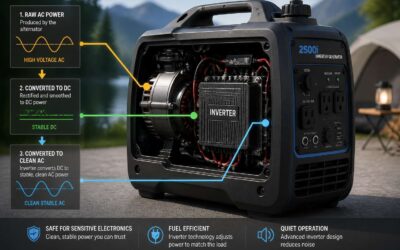
The inverter then converts stored DC into the AC your appliances expect. A pure sine wave inverter runs electronics without hum. The size dictates practical limits:
- Continuous watts for steady loads
- Surge watts for motors and fridges
- Efficiency at partial loads
A 500W unit handles a laptop, but not a microwave. Charge controllers and inverters must match the battery voltage, or the entire system drifts out of sync.
Comparing Monocrystalline and Polycrystalline Panels
The average efficiency gap between monocrystalline and polycrystalline panels sits around 4 percentage points, a margin that alters daily charging timelines. Monocrystalline cells, cut from a single silicon ingot, convert more sunlight into electricity per square metre. Polycrystalline cells, melted from multiple fragments, sacrifice efficiency for a lower price. For solar generators with solar panels, this comparison determines whether you carry a compact unit or a bulky one.
Consider the practical distinction:
- Monocrystalline performs better in low light, such as an overcast Highveld afternoon.
- Polycrystalline handles heat with less efficiency loss, useful in Limpopo’s summer.
The choice often comes down to budget and available space. A monocrystalline panel reduces the generator’s physical size. A polycrystalline panel lowers the initial purchase price. Both supply the same battery, but the time to full charge differs noticeably.
Choosing the Right Power Capacity for Your Needs
Calculating Your Daily Wattage Requirements
As the sun retreats behind Table Mountain and the city grid falters, I have learned to measure my survival in watts. Choosing the right capacity for your solar generators with solar panels begins with a stark audit of your daily appetite for electricity.
To calculate your daily wattage requirements, list every device that breathes when the lights die. Then multiply each wattage by hours of use. The sum is your unforgiving number. Consider these steps:
- Record the wattage from each appliance’s label, not your guess.
- Estimate hours of operation per day during an outage.
- Multiply and total the result.
The full sum must be met by your generator’s battery and panels. Oversizing leaves coin wasted, while undersizing leaves you in the dark. In this country, the margin for error is thin, so be honest with your arithmetic.
Sizing the Solar Array for Faster Recharging
My neighbour’s solar array outshines mine, yet we both survive the same eight hour blackouts. The difference is how quickly their batteries recover. Choosing the right power capacity for your needs is only half the equation; the solar array itself determines whether you are ready for the second night.
Sizing the solar array for faster recharging means matching panel output to your battery bank. In South Africa, expect roughly four peak sun hours. A 200 watt panel feeding a 1 kWh battery will take longer than a 400 watt panel, naturally. For solar generators with solar panels, the trick is balancing rooftop space and budget.
- Calculate your battery capacity in watt hours.
- Divide by peak sun hours in your town.
- Add twenty percent for inefficiency.
The answer is the minimum panel wattage required. Oversize slightly if you want to run a kettle before sunset.
Battery Capacity Measured in Watt-Hours
The nameplate on every battery in South Africa tells a quiet lie. A 500 watt-hour power station will not give you 500 watt-hours of usable energy. Inverters, charge controllers, and chemical losses consume roughly fifteen percent before your kettle ever sings. That distinction between rated capacity and real-world capacity matters more than any spec sheet suggests. For solar generators with solar panels, the watt-hour rating sets the upper bound of what you can carry through load-shedding, yet the practical figure is always lower.
Consider a typical evening:
- A modem drawing 10 watts for six hours consumes 60 watt-hours.
- A laptop drawing 45 watts for three hours consumes 135 watt-hours.
- A LED TV drawing 60 watts for four hours consumes 240 watt-hours.
Those three loads total 435 watt-hours, so a 500 watt-hour unit barely suffices. In South Africa, where blackouts often stretch past four hours, choose a battery bank that covers your nightly draw twice over. Solar generators with solar panels should deliver surplus, not mere adequacy.
Peak Power vs. Continuous Power Output
Most buyers obsess over battery size, but the inverter’s limits bite first. A 1000 watt inverter will not start a 2000 watt kettle, and it will not keep a 1500 watt heater alive for long. That is the difference between peak power and continuous power output.
Peak power handles surge demands like motor starts or compressor kick-on. Continuous power is what the unit sustains hour after hour. For solar generators with solar panels, match the continuous rating to your heaviest daily load, not your momentary spike. Here is a quick guide:
- Continuous: your kettle, toaster, and fridge.
- Peak: a laser printer or power tool startup.
Portable Units vs. Whole-Home Backup Systems
South Africans know the dark intimately. Load shedding has taught us to count watts carefully. When choosing between a portable solar generator and a whole home backup system, the question is not size, but what you refuse to lose.
A portable unit paired with solar generators with solar panels serves the householder whose weekly need stays narrow: router, laptop, alarm system, one fridge. Whole home systems require a harder inventory. Do you power the geyser during outages, or protect only essential circuits?
- Portable units run from 300Wh to 2000Wh, enough for lights and a laptop
- Whole home systems start near 5000Wh and wire into your distribution board
Personally, I have watched neighbours sacrifice everything to a single extension cord. When buying solar generators with solar panels, choose your capacity from your heaviest nightly load, not your daytime optimism.
Setup, Placement, and Installation Best Practices
Positioning Panels for Optimal Sun Exposure
In South Africa, the sun’s arc changes dramatically from Cape Town to Mpumalanga. That is why setting up solar generators with solar panels demands more than just pointing them skyward! I have learned that the difference between a mediocre and a stellar charge often comes down to a few degrees of tilt and a deliberate scan for obstructions.
For most of the country, true north is your target, not magnetic north. Then, set the panel angle to match your latitude, around 26 degrees in Johannesburg. Shade is the silent enemy; even a single branch can halve output. Consider these placement checks:
- Look for any shadows at 10am and 2pm.
- Confirm the panel faces north without any tilt beyond 30 degrees.
That simple audit usually boosts daily yield by 20 percent in my tests.
Connecting Panels to the Generator Safely
In my years wiring solar generators with solar panels, I have learned that the cable is the most critical component. A secure setup begins with a level generator base and a clean, dry surface. Panels should sit at a stable angle, with their leads routed away from sharp edges.
For safe installation, connect the positive terminal to the generator’s input first, then the negative. This sequence prevents sparking near the battery, and I have verified it repeatedly. A check list helps:
- verify polarity
- tighten every connection
- inspect for frayed sheathing
After that, run a test charge. I always torque the terminals with a spanner instead of a screwdriver. Because solar generators with solar panels rely on consistent contact, a loose plug will cut output to nothing!
First-Time Setup Checklist for Beginners
Most first-time owners overlook the ground beneath their feet. A stable, level surface matters more than the brand of your solar generators with solar panels. I once watched a setup fail because a slight slope shifted the unit mid-charge. Place the system on compacted soil or concrete, away from foot traffic. Leave a hand’s width of clearance for airflow.
Inspect the frame for warping before you mount anything. Use the included brackets to secure panels to a fixed surface. A rattling panel wears out its connectors fast.
A first-time checklist prevents costly mistakes:
- Unpack all components and cross-check the inventory.
- Set the generator on a dry, level pad.
- Test each cable for continuity.
Work through each step slowly. The reward is a quiet, reliable system.
Maintenance, Safety, and Longevity
Cleaning and Caring for Your Solar Panels
Dust and bird droppings can cut solar panel output by 25% within a month. In South Africa’s dry regions, this loss arrives fast. Cleaning is a regular ritual.
Use deionised water and a soft brush. Avoid abrasive pads. Mild dish soap works; harsh chemicals strip protective coatings. Rinse before water dries.
- Inspect seals for cracks.
- Tighten mounting bolts.
- Check cables for damage.
Disconnect the generator before cleaning. Low light still generates voltage. A maintained panel lasts 25 years. Your solar generators with solar panels rely on this care.
Extending Battery Lifespan with Proper Storage
Battery storage determines the real lifespan of solar generators with solar panels. Heat causes the most damage. A unit left in a parked vehicle in the Karoo loses capacity sooner than one kept in a cool pantry. Keep the generator between 10°C and 25°C when idle.
Charge to roughly 60% before storing it for weeks. A full charge stresses the cells; a fully depleted pack damages them permanently. Top the battery back to that mark every few weeks, and check these details:
- Inspect terminals for corrosion
- Confirm the charge controller is not drawing current
- Check the housing for swelling or cracks
Safety matters here. A swollen battery indicates internal failure. Stop using it and dispose of it properly. A stable storage environment protects the inverter and wiring too. Careful storage keeps solar generators with solar panels reliable for a decade or more.
Weatherproofing Your Setup for Outdoor Use
Dust, rain, and ultraviolet radiation have separate attack plans for outdoor equipment. South Africa’s Highveld brings afternoon thunderstorms while the coast contributes salt-laden air. A weatherproofed setup considers all three without compromising airflow. The enclosure material matters as much as the seal quality.
- Rainwater pooling on the panel frame
- UV degradation of plastic cable glands
- Windborne grit entering ventilation slots
Permanent outdoor placement changes how thermal stress accumulates inside the inverter housing. Solar generators with solar panels tolerate occasional showers, yet continuous sun heats battery cells beyond safe limits. Positioning the array for morning light while shading the main unit reduces this burden.
Fastening systems prevent displacement during storm gusts, and screened vents maintain the exchange of air without inviting debris. A proper weatherproofing strategy treats humidity, temperature, and mechanical force as connected threats. Robust equipment survives years of outdoor duty when protective elements remain intact.
Electrical Safety and Overload Protection
South Africa’s grid volatility makes overload protection a practical concern. When I evaluate solar generators with solar panels, I look for inverters that cut output before wiring temperature climbs. A thermal breaker resets cleanly after fault clearance. The battery management system cannot shield every downstream component.
Regular maintenance keeps these layers honest. Corroded terminals alter resistance and mimic overload conditions. Loose connections produce heat that degrades insulation. An annual thermal camera inspection reveals hot spots before they become failures. Here are the warning signs I treat as urgent:
- Voltage drop under modest load
- Buzzing sound from the inverter
- Warm casing on the charge controller
- Burnt smell near the DC isolator
Each symptom points to a specific weakness. Addressing them promptly extends the life of the power station. Overload protection works only when the circuit stays clean. I have seen solar generators with solar panels fail because owners skipped torque checks.
Troubleshooting Common Performance Issues
Performance degradation in solar generators with solar panels is rarely a single dramatic event. The unit simply produces less each month, a few watts lost through corroded contacts and tired insulation. South Africa’s climate accelerates this: dust films on the glass, thermal cycling on solder joints, UV exposure on cables.
I compare real output against the datasheet each season. A 5% deviation warrants attention. A 10% deviation demands action! The cause is usually impedance in the battery terminals or the MC4 connectors. Cleaning, retorquing, and dielectric grease restore most of the lost capacity.
Longevity follows a discipline of small interventions. The owner who measures, tightens, and shields the system from heat will see years beyond the warranty. Solar generators with solar panels reward this attention. The sun remains constant. The hardware drifts. Your maintenance closes that gap.
Real-World Applications and Environmental Benefits
Camping, RVing, and Overlanding Adventures
The Karoo at dusk offers silence, but your devices demand power. Solar generators with solar panels supply electricity without the noise or fumes of a petrol engine. For RVers along the Garden Route, these units charge quietly while parked under a tree, ready for the next morning’s coffee.
Overlanders crossing the Richtersveld use the same systems to run fridges, charge radios,and power lights at night. Each kilowatt-hour captured by the panel reduces fuel consumption, lowering emissions and keeping campsites quieter. The environmental benefit is clear in cleaner air and undisturbed wildlife.
- Keep your drone ready for mapping trails
- Power a laptop for evening route planning
- Run a portable cooler for fresh food
These practical uses show how portable solar turns remote stays into extended adventures, without a heavy impact!
Emergency Backup During Power Outages
During load shedding, a solar generator becomes essential equipment. South Africans know the frustration of a darkened home, the fridge defrosting, the router silent. Solar generators with solar panels turn those hours into manageable intervals. A single unit keeps a Wi-Fi router, a laptop, and several LED lights running through a two-hour outage.
The environmental benefit compounds with every blackout. Instead of burning diesel or petrol for a backup generator, you draw power from the sun. No fumes, no noise, no fuel queues!
- Keep the router alive for remote work
- Power a medical device such as a CPAP machine
- Charge phones and torches for the household
Each charge cycle reduces reliance on Eskom’s coal-fired grid, cutting emissions and keeping your home functional when the lights go out.
Off-Grid Cabins and Remote Workstations
Somewhere in the Cederberg, a writer submits a manuscript from a cabin that has never seen a grid connection. I have stood beside a stone cottage in the Karoo while the router hummed and the laptop charged, all from a device that fit into a car boot! Solar generators with solar panels now power remote workstations that once demanded diesel or a long extension cord.
- Laptop and external monitor for full workdays
- Satellite router for connectivity
- LED lighting and a small fridge
The environmental benefit follows each charge. A typical diesel generator burns about a litre per hour under load. A solar unit draws from daylight and stores it. Over a season of weekend work, the difference appears in fuel bills and cleaner air, and each session replaces power that would have come from combusted fuel.
Reducing Your Carbon Footprint with Clean Energy
Every litre of diesel saved matters. In my own travels across the Free State, I have watched solar generators with solar panels run fence energisers and workshop tools without a single exhaust plume. The math is simple: no fuel, no fumes, no tank refills at a distant garage. Each charge cycle erases a bit of combustion that once hung in the morning air.
These units replace the old pattern of generator and petrol can. The unit sits silent in the bakkie, and the morning starts with birdsong instead of a two-stroke whine. Consider what changes:
- A farm workshop powered for a week
- Water pumps for livestock troughs
- Lights for evening calving checks
The carbon footprint shrinks with every kilowatt hour drawn from daylight. South Africa’s sun is a reliable ally, and solar generators with solar panels turn that abundance into quiet, clean power. That is the real benefit, measured in cleaner lungs and a lighter footprint.
Choosing the Right Accessories to Maximize Efficiency
I have watched solar generators with solar panels power a shearing shed through an entire afternoon. The only sound was wool cutting and the occasional bleat. No diesel haze settled on the fleece! That quiet operation is the environmental benefit that matters in South Africa’s farming heartland.
- Fence energisers that hold the boundary overnight
- Submersible pumps for boreholes
- Workshop grinders and drills
Maximising efficiency relies on accessory choices. A tilt bracket recovers more sunlight in winter. Heavy-gauge extension leads prevent wattage losses between panel and generator. Properly sized connectors stop heat build-up. These small selections turn a good solar system into a dependable one.

0 Comments