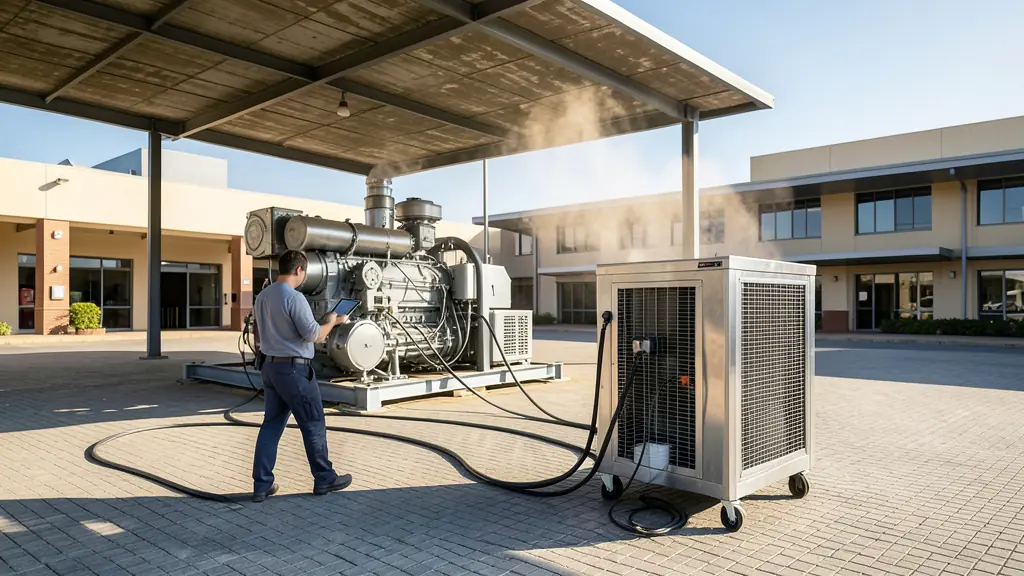
Generator load bank testing runs a generator against an artificial load, usually up to its full rated output, to prove it will carry the building when the mains fails. Through GeneratorRepair.co.za you send one request and independent testing specialists and generator service companies quote you directly. We do not do the testing ourselves. Load bank tests are standard for hospitals, data rooms, cell sites and anyone whose insurer asks for proof of standby capacity, and they are the cure for wet stacking on diesel sets that spend their lives lightly loaded.
Why generator load bank testing matters
A monthly no-load run proves a set starts, not that it can carry 100 percent. Under full load, weak injectors, a clogged radiator, a tired AVR or a slipping fan belt show up as falling frequency, overheating or shutdown. Load testing finds these before a real outage does. It also documents the result: a report with voltage, frequency, current and temperatures at each load step, which insurers, auditors and hospital licensing inspectors accept as evidence.
Wet stacking and light loading
Diesel engines like to work. A 100 kVA set carrying 15 kVA of lights and fridges never gets hot enough to burn all its fuel, so unburnt diesel and soot collect in the exhaust and cylinders. This is wet stacking: black oily drips from the exhaust, glazed cylinder bores and lost power. Running the set at 70 to 100 percent load on a load bank for two to four hours usually clears it. Oversized home and estate sets are common culprits, which is why sizing matters when you look at diesel generators.
A diesel generator load test procedure
A typical diesel generator load test procedure looks like this:
- Pre-checks of oil, coolant, fuel, battery and connections
- The load bank cabled to the generator output or a test point on the changeover panel
- Load applied in steps of 25, 50, 75 and 100 percent, held for 30 to 60 minutes each
- Readings logged at every step, with block load tests to check the set picks up sudden load
- A cool-down run and a written report with any faults found
Resistive load banks test kW only. Resistive and reactive banks test the full kVA at 0.8 power factor, closer to real motor loads.
Costs and how often to test
As a guide, load bank testing of a 20 to 100 kVA set costs R4,500 to R12,000, and 250 to 1,000 kVA sets R12,000 to R40,000 including transport of the load bank. Critical sites test once a year, with shorter tests after major repairs. Many owners add it to a generator maintenance contract. Faults found during the test are quoted as generator repairs.
What to include in your request
- Give the kVA rating and number of sets
- Say whether a written report is needed
- Note the cable distance from set to load bank
- Mention signs of wet stacking or black oil
- State any insurer or licensing requirement
Load Bank Testing for different sites
- Homes: rarely needed, though large oversized home sets with wet stacking benefit from a full load run
- Estates and complexes: an annual load test on the body corporate's main set to prove it carries every unit
- Farms and smallholdings: load testing a dairy or irrigation set before the season to check it handles pump starts
- Shops, offices and restaurants: a yearly test on shopping centre and office park sets for tenants and insurers
- Factories, mines and sites: full load and block load tests on factory and mine sets with reactive load banks
- Lodges, venues and events: testing lodge and venue generators that sit lightly loaded for months
- Clinics, schools and towers: documented annual testing of hospital, clinic and data room standby generators
Frequently asked questions
Is GeneratorRepair.co.za a load bank testing company?
Will the building lose power during a load bank test?
How long does a load bank test take?
Does a generator at altitude need special testing?
Load Bank Testing by province and city
- Johannesburg
- Pretoria
- Centurion
- Midrand
- Sandton
- Randburg
- Roodepoort
- Krugersdorp
- Randfontein
- Germiston
- Boksburg
- Benoni
- Kempton Park
- Alberton
- Vanderbijlpark
- Vereeniging
- eMalahleni (Witbank)
- Middelburg
- Secunda
- Mbombela (Nelspruit)
- Rustenburg
- Brits
- Klerksdorp
- Potchefstroom
- Mahikeng
- Polokwane
- Tzaneen
- Kimberley
- Upington
- Bloemfontein
- Welkom
- Sasolburg
- Durban
- Pinetown
- Pietermaritzburg
- Richards Bay
- Newcastle
- Ladysmith
- Gqeberha (Port Elizabeth)
- East London
- Kariega (Uitenhage)
- Mthatha
- Cape Town
- Bellville
- Paarl
- Stellenbosch
- George
- Worcester